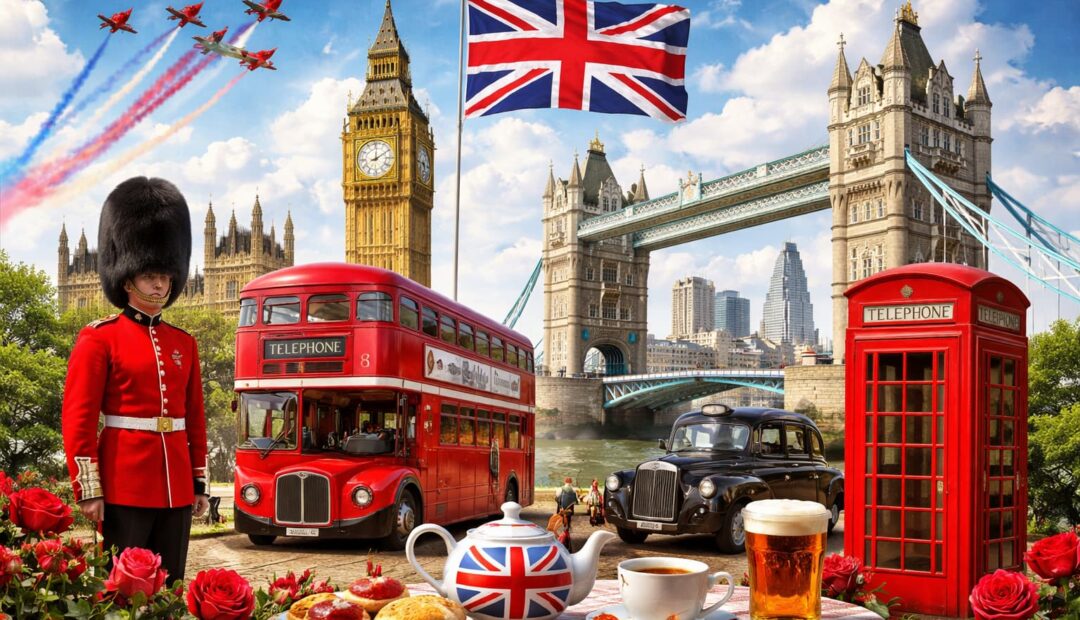
England’s global influence extends far beyond geography. Through literature, governance, education, sport, and national symbolism, it has shaped how the world thinks, communicates, and connects. From the enduring words of Shakespeare to the worldwide reach of English football, these cultural icons reveal how England secured a lasting place on the global stage through ideas that continue to resonate across generations.
Introduction: How England’s Culture Became Global Currency
England’s global influence is often discussed in political or economic terms, yet its most enduring legacy lies elsewhere—in cultural exchange. Cultural influence does not depend on borders, armies, or trade balances. It spreads through ideas, stories, symbols, institutions, and habits that quietly integrate themselves into daily life across the world.
England achieved this form of influence through institutional continuity. Its cultural icons did not emerge in isolation; they were supported by systems that allowed them to endure—schools that taught them, theatres that performed them, parliaments that embodied them, and media that amplified them. Over time, these icons became global reference points, shaping how people understand language, governance, creativity, and identity.
This series examines nine cultural icons that placed England firmly on the global map. Each represents a distinct sphere of influence, yet together they form a coherent picture of how English culture achieved long-term global relevance.
1. Big Ben and the Palace of Westminster
Architecture as a Statement of Political Values
Big Ben and the Palace of Westminster are among the most recognisable political landmarks in the world. Their significance lies not only in their appearance, but in what they represent. The Gothic Revival architecture deliberately communicates tradition, authority, and continuity, reinforcing the legitimacy of parliamentary governance rather than personal rule.
Unlike monumental structures designed to glorify individuals, the Palace of Westminster symbolises institutions. It conveys the idea that governance is ongoing, structured, and bound by rules. Big Ben’s regular chimes reinforce this message, marking time as something measured, shared, and publicly accountable.
Global Recognition Through Media and History
For decades, Big Ben’s image and sound have been used in international broadcasts, particularly during moments of political importance or historical change. This consistent association with reliability and order turned the tower into a global symbol of democratic process.
Countries that adopted parliamentary systems often looked to England as a model. As a result, Big Ben became more than a London landmark—it became a visual metaphor for representative government itself. Its global recognition reflects England’s lasting contribution to political organisation and civic culture.
2. William Shakespeare
The Writer Who Shaped Global Storytelling
William Shakespeare’s cultural influence is unparalleled. He did not merely write plays; he redefined how stories function. His characters possess psychological depth, moral ambiguity, and emotional realism that remain compelling centuries later. These qualities allow his work to cross cultural and linguistic boundaries with ease.
Shakespeare’s exploration of power, love, ambition, betrayal, identity, and mortality speaks to universal human experience. This universality explains why his plays are continually adapted—set in different eras, cultures, and political contexts—without losing relevance.
Language as Cultural Power
Shakespeare profoundly shaped the English language. He introduced or popularised thousands of words and phrases still used today. As English spread globally through education, administration, and media, Shakespeare’s linguistic influence travelled with it.
Educational systems worldwide adopted his works as core texts. This ensured that generations of students encountered English culture through Shakespeare first, embedding England’s literary voice into global education and reinforcing its cultural authority.
3. The Beatles
From Local Band to Global Cultural Force
The Beatles emerged from post-war England at a moment of social and cultural transition. They transformed popular music by proving that it could be artistically ambitious, emotionally expressive, and commercially successful at the same time. Their approach to songwriting and studio experimentation reshaped the music industry worldwide.
They also changed how musicians related to audiences. The Beatles wrote their own material, challenged conventions, and embraced creative evolution. This inspired artists across continents to prioritise originality and personal expression.
Redefining England’s Cultural Image
Before The Beatles, England was often associated internationally with tradition and restraint. Their success projected a different image—one of creativity, experimentation, and cultural confidence. They positioned England as a leader in modern popular culture, not merely a guardian of historical legacy.
Their influence extended beyond music into fashion, youth identity, and social attitudes. Even decades later, they remain central to discussions of global cultural change, reinforcing England’s reputation as a source of creative leadership.
4. Premier League
Football as a Global Cultural Language
Football occupies a unique position in global culture, and the Premier League stands at the centre of that influence. What began as a domestic competition evolved into one of the world’s most powerful cultural exports. Its transformation was driven by professional organisation, international broadcasting, and the deliberate positioning of football as entertainment as well as sport.
Unlike many leagues, the Premier League markets not only elite teams but also the league itself as a unified product. This approach created a consistent global identity, making English football accessible and recognisable to audiences regardless of geography. As a result, fans in Asia, Africa, Europe, and the Americas follow English clubs with the same loyalty as local teams.
Cultural Identity, Community, and Soft Power
The Premier League functions as a form of cultural diplomacy. Football clubs act as ambassadors for English cities, transmitting local traditions, rivalries, and identities worldwide. Stadiums, chants, and matchday rituals become familiar cultural markers for international audiences.
Beyond entertainment, the league projects values associated with English sporting culture—competition, resilience, fair play, and community connection. This form of soft power allows England to maintain cultural relevance without political messaging. Through football, England remains emotionally present in the lives of millions, reinforcing its global cultural standing.
5. British Museum
England as a Custodian of Global Heritage
The British Museum represents one of the most significant cultural institutions in the world. Its collections span continents and millennia, offering a comprehensive narrative of human civilisation. This breadth positions England as a central participant in the documentation, interpretation, and preservation of global history.
More than a repository of objects, the museum functions as an educational institution. Scholars, researchers, and visitors from around the world engage with its collections, reinforcing England’s role as a hub of historical knowledge and academic exchange.
Cultural Authority and Ethical Dialogue
The British Museum also occupies a complex position within global cultural discourse. Questions surrounding provenance, restitution, and historical responsibility have made it a focal point for ethical debate. Rather than diminishing its influence, these discussions have increased its relevance.
By engaging with these issues, the museum reflects England’s evolving role in global cultural stewardship. It demonstrates that cultural influence is not static but involves continuous reflection, responsibility, and dialogue. This openness ensures that England remains central to international conversations about heritage and history.
6. Stonehenge
Deep History and the Origins of Cultural Identity
Stonehenge occupies a unique position in England’s cultural landscape. Constructed long before written records, it connects modern society to prehistoric ingenuity. Its scale, precision, and alignment reveal a sophisticated understanding of engineering, astronomy, and ritual life among early communities.
This connection to deep time strengthens England’s cultural narrative. Stonehenge demonstrates that England’s history did not begin with monarchy or empire, but with early human cooperation and symbolic thought.
Global Fascination and Universal Meaning
Stonehenge’s mystery is central to its cultural power. Despite centuries of study, its precise purpose remains debated. This uncertainty invites interpretation and imagination, allowing people from different cultures to project their own meanings onto the monument.
As a UNESCO World Heritage Site, Stonehenge symbolises humanity’s shared past. It places England within a broader human story, reinforcing global recognition of its ancient roots and its role in preserving early cultural achievements.
7. Buckingham Palace
Monarchy as Cultural Continuity Rather Than Power
Buckingham Palace is not merely a royal residence; it is the most visible symbol of England’s constitutional monarchy. Unlike absolute monarchies of the past, England’s monarchy evolved into a ceremonial institution that represents continuity, national identity, and tradition rather than political authority. This transformation is central to its global appeal.
The palace functions as a stage for national rituals—state visits, official ceremonies, and moments of collective significance. These events are broadcast worldwide, reinforcing England’s image as a nation where history and modern governance coexist. The monarchy’s restraint and symbolic role distinguish it from other political systems and contribute to its enduring fascination.
Global Recognition and Diplomatic Influence
Buckingham Palace plays a significant role in international diplomacy. State visits hosted at the palace reinforce England’s status as a long-standing participant in global political and cultural dialogue. The formality, pageantry, and protocol associated with these occasions convey stability, respect, and institutional continuity.
For many international audiences, the palace represents England itself. It has become embedded in global consciousness through media coverage, literature, and popular culture. This visibility ensures that England’s political traditions remain recognisable and relevant, even to those unfamiliar with its constitutional details.
8. University of Oxford and University of Cambridge
Universities as Engines of Global Influence
Oxford and Cambridge are not simply educational institutions; they are pillars of England’s intellectual identity. Together, they represent centuries of scholarship, debate, and research that shaped global understanding of science, philosophy, law, politics, and literature. Their influence extends far beyond England’s borders through alumni, academic partnerships, and research output.
These universities helped define the modern university model. Their emphasis on critical thinking, tutorial-based learning, and academic independence influenced higher education systems worldwide. As a result, England became associated with intellectual rigour and educational credibility.
Knowledge, Leadership, and Cultural Authority
Graduates of Oxford and Cambridge have played central roles in shaping global history—as political leaders, scientists, economists, writers, and thinkers. This concentration of influence reinforced England’s reputation as a producer of leadership rather than merely an exporter of ideas.
More importantly, these institutions established knowledge itself as a form of cultural power. By prioritising inquiry, debate, and evidence, they positioned England as a centre of intellectual authority. This legacy continues to shape how England is perceived within global academic and policy-making circles.
9. Union Jack
A Flag That Carries History and Meaning
The Union Jack is one of the most instantly recognisable national symbols in the world. Its design reflects England’s political evolution, incorporating elements that represent unity, conflict, and historical compromise. Unlike many flags that function purely as identifiers, the Union Jack tells a story.
Over time, the flag became associated not only with the state but with broader cultural expression. Its visibility increased through global trade, historical influence, and widespread representation in media, art, and fashion.
Cultural Adaptability and Global Presence
What makes the Union Jack distinctive is its adaptability. It has been used in contexts ranging from patriotic celebration to artistic reinterpretation and political critique. This flexibility allows it to remain culturally relevant rather than static.
Its presence in global fashion, music, and visual culture ensures that England remains symbolically visible worldwide. Even when reinterpreted or challenged, the flag reinforces England’s enduring place within global cultural consciousness.
Frequently Asked Questions (FAQs)
1. Why is England considered one of the most culturally influential countries in the world?
England’s cultural influence developed through centuries of contribution to language, governance, education, art, and sport. These contributions were embedded in institutions that allowed ideas to spread globally and endure over time. English literature, parliamentary democracy, higher education models, and popular culture became reference points worldwide, ensuring England’s cultural presence remained relevant long after political or economic power shifted.
2. How did William Shakespeare contribute to England’s global cultural identity?
William Shakespeare shaped global storytelling and language by introducing complex characters, universal themes, and expressive linguistic forms. His works are studied and performed worldwide, forming a foundation of English literature education. As English spread internationally, Shakespeare’s influence travelled with it, embedding England’s literary voice into global culture and reinforcing its long-standing authority in language and the arts.
3. Why is the Premier League more than just a football competition?
The Premier League functions as a global cultural platform rather than a purely sporting league. Through international broadcasting, diverse talent, and strong club identities, it connects millions of fans worldwide. English football clubs act as cultural ambassadors for their cities, transmitting local traditions and values globally. This makes the league a powerful example of cultural influence through sport and shared experience.
4. What makes institutions like Oxford and Cambridge globally significant?
Oxford and Cambridge shaped modern higher education through centuries of scholarship, research, and leadership development. Their teaching models influenced universities worldwide, while their alumni played major roles in global politics, science, and culture. By prioritising critical inquiry and intellectual independence, these institutions established England as a centre of academic excellence and long-term intellectual authority.
5. Why does the British monarchy continue to attract global attention?
The British monarchy attracts global interest because it represents continuity, tradition, and constitutional balance rather than political control. Ceremonial events, state visits, and royal traditions are widely broadcast, reinforcing England’s distinct political culture. The monarchy’s symbolic role provides stability in a changing world, making it a powerful cultural institution that sustains international fascination and recognition.
6. How does heritage, such as Stonehenge and the British Museum, strengthen England’s global image?
Heritage sites and institutions connect England to shared human history. Stonehenge links modern society to prehistoric civilisation, while the British Museum preserves global artefacts for education and research. Together, they position England as a guardian of historical knowledge and cultural memory, reinforcing its role in global heritage preservation and intellectual dialogue.
7. Why is the Union Jack recognised and used worldwide?
The Union Jack became globally recognisable through history, trade, media, and cultural exchange. Its design reflects England’s political evolution and union history, while its adaptability allows reinterpretation in fashion, art, and popular culture. This versatility keeps the flag culturally relevant, ensuring England remains symbolically visible and identifiable across diverse global contexts.
Closing Perspective
England’s global cultural standing is not the result of isolated achievements, but of interconnected institutions and ideas that reinforced one another over centuries. Monarchy, education, symbolism, governance, creativity, and sport collectively shaped a cultural identity that travelled well beyond national borders.
What unites all nine cultural icons explored in this series is their capacity for continuity. They evolve without losing meaning, adapt without abandoning identity, and remain relevant across generations. This durability explains why England continues to occupy a central place on the global cultural map—not through dominance, but through enduring influence.