The Victorian era wasn’t just a chapter in England’s history — it was the engine room of the modern world. From dramatic social reforms to incredible scientific progress, the 19th century remains one of the most defining periods in British history. It was an age of ambition, invention, and contradictions that still echo in society today.
Introduction
The Victorian era, named after Queen Victoria, who reigned from 1837 to 1901, marked a time of extraordinary change in England. It was a century of industrial progress, imperial expansion, and sweeping social transformation. For many, this period represents the height of British power and influence — when London was the capital of a global empire, and English innovations reshaped the world.
But behind the steam engines and splendid architecture were people navigating new realities — rapid urbanization, poverty, shifting gender roles, and class tensions. The Victorian age was complex, filled with both achievements and hardships, and crucial in shaping modern Britain.
1. Industrial Revolution: The Making of a Modern Nation
A Manufacturing Powerhouse
Factories multiplied across cities like Manchester, Birmingham, and Sheffield, producing textiles, steel, and machinery on an unprecedented scale. This rapid industrialisation made Britain the world’s leading economic power.
Fact: By 1851, over half of Britain’s population lived in urban areas, compared to just 20% a century earlier.
The Railway Revolution
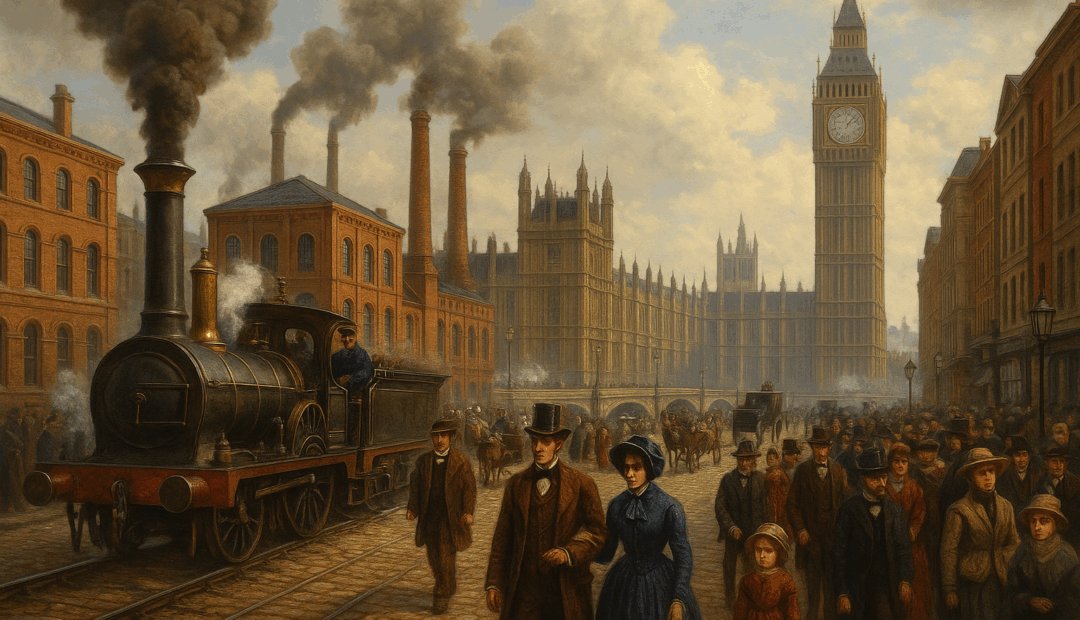
The railways transformed daily life, connecting towns and cities, enabling trade, and opening travel to ordinary citizens.
Fact: By 1850, Britain had more miles of railway than the rest of the world combined.
Tip: You can still ride on preserved Victorian railways in York, Swindon, and the Lake District for a glimpse into the past.
2. Science, Medicine, and Innovation
The Victorian era produced pioneers whose discoveries changed the world.
- Charles Darwin published On the Origin of Species in 1859, revolutionising biology.
- Michael Faraday advanced electromagnetism, laying the foundation for modern electricity.
- Florence Nightingale professionalised nursing and reformed hospital hygiene.
- Joseph Lister introduced antiseptic surgery in the 1860s, saving countless lives.
Fact: In 1842, anaesthetic ether was first used in surgery, making complex operations possible.
Tip: Visit the Science Museum in London to explore Victorian scientific breakthroughs firsthand.
3. The Empire on Which the Sun Never Set
Global Expansion
At its height, the British Empire ruled nearly a quarter of the Earth’s landmass. Territories across Africa, Asia, and the Caribbean fell under British control, spreading its language, culture, and trade systems.
Fact: The Great Exhibition of 1851 in London’s Crystal Palace welcomed over six million visitors, showcasing Britain’s industrial and imperial achievements.
Naval Dominance
The Royal Navy safeguarded global trade routes, ensuring Britain’s position as the world’s dominant maritime power.
Tip: For a closer look, visit HMS Warrior in Portsmouth, a restored Victorian warship.
4. Society and Daily Life
Contrasts Between Classes
Life in Victorian Britain varied dramatically:
- The wealthy enjoyed luxury, fine dining, and country estates.
- The poor crowded into slums with little sanitation or health care.
Fact: In London’s East End, some families of six or more lived in a single room.
The Rise of the Middle Class
Reforms in politics and education gave rise to a new middle class of shopkeepers, professionals, and entrepreneurs. This reshaped society’s balance of power.
Fact: The Education Act of 1870 introduced compulsory schooling for children aged 5 to 10.
5. Women and the Struggle for Equality
Women were expected to remain in the domestic sphere, but many challenged these restrictions. Campaigners such as Josephine Butler and Millicent Fawcett laid the foundations of the women’s suffrage movement.
Fact: By the 1890s, women could attend universities such as Cambridge and Oxford, although often with limited rights.
Tip: Explore the Museum of London’s Victorian women’s exhibits to see how roles shifted across the century.
6. Victorian Arts, Literature, and Culture
Literature That Defined an Era
Victorian authors highlighted both the achievements and struggles of society.
- Charles Dickens exposed poverty and injustice.
- Charlotte Brontë and Emily Brontë explored themes of love and independence.
- Alfred Lord Tennyson became the poet laureate of the age.
Fact: Dickens’ A Christmas Carol (1843) helped popularise Christmas traditions we still enjoy today.
Art and Architecture
The Gothic Revival style flourished, producing landmarks such as the Houses of Parliament and St Pancras Station. The Pre-Raphaelite Brotherhood added drama and detail to Victorian art.
7. Religion, Morality, and Reform
The Victorians were deeply concerned with morality, faith, and duty. Evangelical movements inspired charitable works, schools, and hospitals. At the same time, scientific progress challenged traditional religious beliefs.
Fact: The Salvation Army, founded in 1865, began its mission to help the urban poor during this period.
8. Public Health, Poverty, and Social Reform
Rapid industrialisation brought not only prosperity but also overcrowding, disease, and poverty. Reformers fought for better conditions:
- The Public Health Act of 1848 began tackling sanitation issues.
- Child labour laws restricted dangerous factory work.
- Charities and reformers worked tirelessly to improve housing and education.
Fact: In the 1840s, outbreaks of cholera killed thousands in London, pushing the government to invest in sewers and clean water systems.
Tip: Explore the Victorian sewers beneath London with special guided tours — a direct link to this era’s urban challenges.
9. Legacy of the Victorian Era
The Victorian period left a lasting impact:
- Britain’s industrial and scientific achievements shaped the modern world.
- Social reforms laid the groundwork for democracy, public education, and healthcare.
- The empire spread English culture and language globally, with legacies still debated today.
Even today, we feel the echoes of the 19th century in our railways, cities, and social debates.
Conclusion
The Victorian era was a time of contradictions — prosperity and poverty, innovation and inequality, empire and reform. It remains one of the most iconic chapters in English history because it defined what Britain, and much of the modern world, would become.
To understand modern Britain, one must understand the Victorian age: an era of industry, empire, morality, and transformation — a period that continues to inspire curiosity, reflection, and debate.